Some of the most interesting details in cabinetry are the ones that are difficult to appreciate from across a room. Beaded inset cabinetry is a particularly good example.
The difference between a beaded and a non-beaded design may be little more than a small shaped detail. Yet its position and proportions can change the way an entire kitchen reads, especially under changing light.
In short, a bead is a small decorative profile that can be incorporated into the face frame, the door or drawer front, or both. The placement is a custom design choice. Non-beaded cabinetry uses simpler edges, letting the reveal and cabinet proportions define the opening.
What is beaded inset cabinetry?
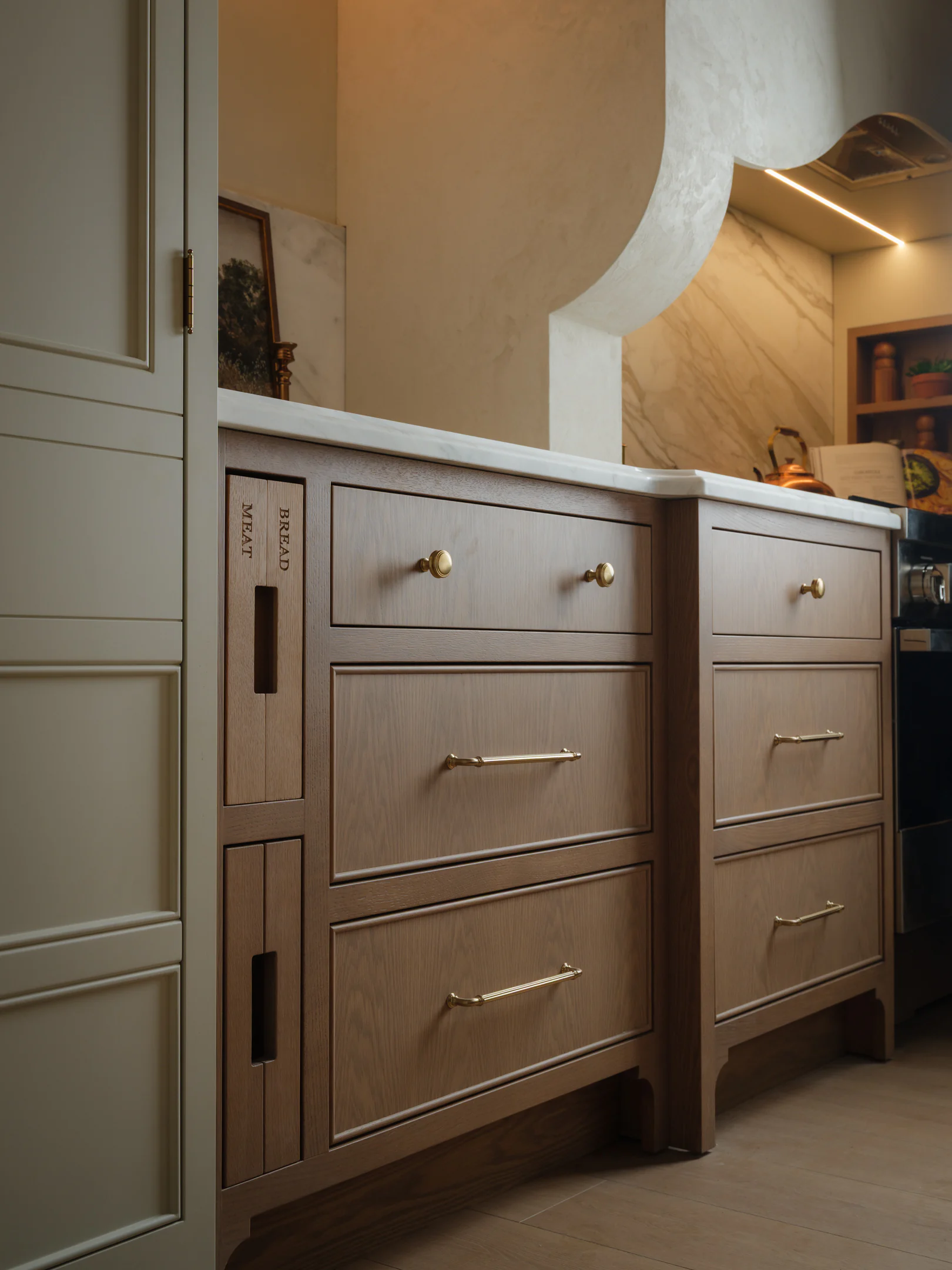
A bead is a small rounded or shaped decorative profile. In traditional beaded-inset construction, it often runs along the inside edge of the face-frame opening. In custom cabinetry, it can instead be placed on a door or drawer front, or used on both the frame and the front. These arrangements are not interchangeable: each creates a different relationship of highlights, shadows and visual detail.
The result can be a fine architectural detail around the opening, an accent within the door design, or a deliberately layered combination. A bead catches light on its curved surface and creates a small shadow that changes how the surrounding surfaces read.
For that reason, the term “beaded inset” is worth clarifying with a drawing or sample. A bead around the inside edge of a face frame is different from a bead incorporated into a door stile, rail or panel detail. At AWDS, either placement, or a considered combination of both, can be specified when its proportions and construction are appropriate to the design.
A drawing or physical sample is often more useful than a style name.
What does a non-beaded frame look like?
A non-beaded inset design uses simpler edges without an added bead at the selected frame or door detail. The relationship between the frame, front and reveal becomes more prominent.
It can still have considerable depth and character. A painted frame without a bead can still be paired with a subtly detailed door, while simple timber fronts may create a quieter appearance.
The absence of a bead does not make the cabinetry less custom or less sophisticated. In many interiors, removing a small decorative element allows the proportions and materials to become more apparent.
How to choose between them
Look at the other architectural details in the home. Are there profiled architraves, panelled walls, detailed fireplace surrounds or traditional furniture? A bead on the frame, the door or both may create a subtle relationship with those elements.
In an interior with relatively simple skirting boards, restrained joinery and large surfaces of natural stone or timber, a non-beaded frame might sit more comfortably.
These are useful starting points rather than rules. A traditional home does not need extensive ornamentation, and a refined contemporary interior can benefit from an unexpected furniture detail.
The most important consideration is how the small profile relates to the larger composition. A kitchen with elaborate doors, prominent hardware and heavily profiled cabinetry may not need another decorative line around every opening.
The manufacturing considerations
A bead adds another detail that must be coordinated with the door construction, the reveal, and the selected hardware. Near an inset opening, its profile must not interfere with the door swing or the intended clearance.
At AWDS, the bead can form part of the face-frame detail, the door or drawer-front detail, or both, depending on the design. Our standard painted doors are 7/8 inch thick. The profile size, corner treatment, placement and operating clearances are resolved during design and engineering, rather than assumed from a photograph.
The transitions at the corners deserve particular attention, whether the bead belongs to the frame, the door or both. A profile that looks beautiful along one straight member must meet adjoining components in a deliberate way.
Finishing adds another consideration. The character of a fine bead depends on its definition remaining clear after preparation and coating. This is particularly noticeable on painted cabinetry, where a small profile can lose some of its clarity if the finish accumulates unevenly.
Is beaded inset cabinetry more expensive?
It can be, depending on how the bead is produced and the complexity of the design. Additional machining, fabrication, finishing or fitting may be required.
The cost should be assessed within the context of the complete project, in the same way as the broader question of why inset cabinets cost more. It is not useful to assume that a certain profile always introduces the same premium.
If the visual difference is important to you, ask to compare finished samples. A profile that looks substantial in a drawing may appear surprisingly discreet once it is painted and installed.
Compare the details in person
We recommend comparing beaded and non-beaded cabinetry under similar lighting, ideally with comparable colours and door profiles. Ask to see the bead on the frame, on the front and, if appropriate, on both. Otherwise it is easy to attribute a difference created by paint, grain or hardware to the bead itself.
Move close enough to examine the corners, then step back and look at the effect across an entire cabinet. The same habit is useful when judging the quality of face frame cabinetry more generally. The second view is just as important as the first.
Ultimately, a bead should contribute to the character of the room without demanding attention. When the proportions are right, it may be a detail you barely notice consciously, yet would miss if it were removed.