Wood is a natural material. Long after it has been machined, assembled and finished, it continues to respond to the environment in which it is used.
This is one of the reasons that manufacturing inset cabinetry requires more than simply achieving a precise fit on the day the doors are installed. The fit must also allow for the conditions the cabinetry will experience in service.
For homeowners in Ontario, where the conditions inside a heated home in winter can differ considerably from those in summer, understanding that relationship is particularly useful.
In short, wood gains moisture and swells when indoor air is humid, and loses moisture and shrinks when it is dry, mostly across the grain. An inset door sits within a fixed opening, so that seasonal movement can narrow or widen its reveal. The clearance around an inset door is designed to accommodate it.
Why wood changes dimension
Wood exchanges moisture with the surrounding air. When conditions become more humid, timber can gain moisture and swell; when conditions become drier, it can lose moisture and shrink.
The movement is not uniform in every direction. Solid wood generally changes dimension much more across its grain than along its length. The species, grain orientation and construction of a component all influence the amount and nature of movement.
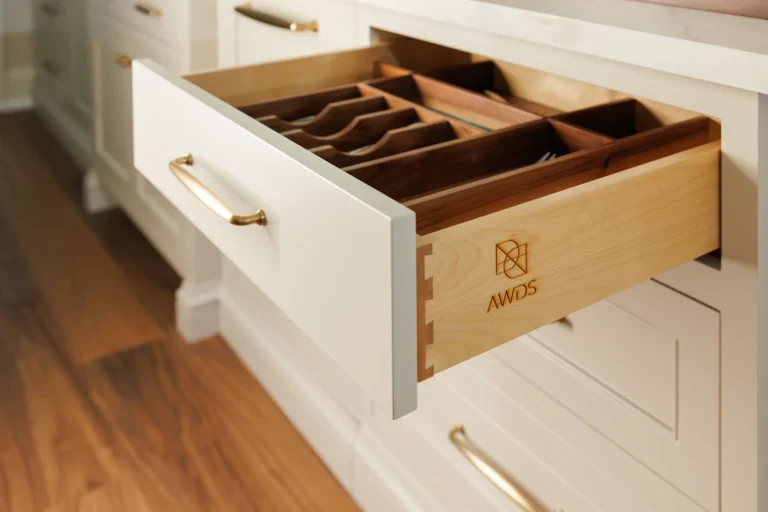
A solid door frame, a veneered panel and a plywood cabinet body will not necessarily respond in the same way. Plywood is comparatively stable because its layers are laid with their grain crossing. In a five-piece door, the centre panel is typically held so that it can move within the door’s own frame. Their construction needs to be considered as a system rather than treated as though every part were made from an identical material.
The face frame moves too. Its stiles and rails are solid hardwood, and each member changes mainly in width rather than in length, so the opening itself can change slightly as well as the door within it.
Why this matters to inset doors
An inset door is surrounded by a relatively fixed opening. The clearance between the door and the frame has to accommodate the ordinary operation of the door and the behaviour of the materials.
At AWDS, typical specified reveals are 3/32 or 1/8 inch, depending on the design; these are our working standards. That dimension is intentional. It is not simply a gap left because the door could not be manufactured more accurately.
If the material expands or an opening moves, some of the available clearance can be lost. If the door contracts, the reveal can become larger. Either effect may be more apparent in an inset arrangement because the surrounding framework provides a visible reference.
Overlay doors also respond to environmental conditions. They simply have a different relationship to the cabinet opening.
What can a cabinetmaker do about it?
The starting point is suitable material preparation and selection. Timber should be appropriate for the environment it is expected to occupy. The construction of the door, the positioning of its components and the choice of hardware should account for the expected behaviour of those materials.
Finishes also play a role. A coating slows the exchange of moisture between wood and its surroundings, but it does not make timber permanently dimensionally stable.
This is why a premium finishing system, important as it is, cannot replace thoughtful engineering and sensible indoor conditions.
Properly fitted and adequately supported cabinet bodies are equally important, as is the construction described in how to recognise well-made face frame cabinets. A door that binds may reflect hardware adjustment, cabinet alignment or something else entirely, rather than simply seasonal changes in the timber.
Preparing the home before installation
New construction and significant renovations can introduce moisture through plaster, concrete, paint and other wet trades. A building that has not reached its intended occupied conditions may expose cabinetry to an environment quite different from the one for which it was designed.
Before installation, discuss site readiness with the cabinetry supplier and the general contractor. The building should have appropriate environmental controls in operation and be sufficiently dry for the materials being installed.
Follow the manufacturer’s project-specific humidity and care recommendations. An inexpensive indoor hygrometer can help you understand how conditions change throughout the year. The appropriate humidity range for a particular home also depends on its construction, climate and building systems; there is no single setting that can be prescribed for every household without considering those factors.
What should you do if an inset door starts rubbing?
First, note when the problem appeared and whether it affects one door or several. A sudden change following a leak or a period of unusual humidity deserves attention. So does a door that becomes progressively harder to operate.
Check for obvious obstructions, such as an item inside the cabinet preventing a door or drawer from closing. Avoid forcing a door against its framework.
If rubbing persists, contact the cabinetry manufacturer or installer. It may be possible to resolve the matter through an appropriate hardware adjustment, but the cause should be understood first.
We would not recommend sanding or planing a finished door yourself. Removing material can permanently change the reveal, damage the finish and interfere with later adjustment or warranty assessment.
Living with timber cabinetry
The objective of good cabinetry construction is not to pretend that wood is an inert material. It is to work with its characteristics, allowing the finished kitchen to function reliably while retaining the qualities that make timber so appealing.
A well-considered reveal, suitable materials, careful installation and an appropriately maintained indoor environment all contribute to that outcome.
Understanding these details can help homeowners appreciate why a little clearance around an inset door is not an imperfection. It is an essential part of a thoughtfully designed cabinet.